Candidate lookup journey
Start from all candidates, then open one profile to verify affidavit, vote share, and track record.
Open candidates → Read focused answer Greatidude Civic intelligence
 Scenario Analysis, Not Prediction
Direct answer High confidence
DMK vs TVK is one of the highest-intent election comparisons. Use constituency-level result margins and winner tables instead of social media claims to validate who is actually ahead.
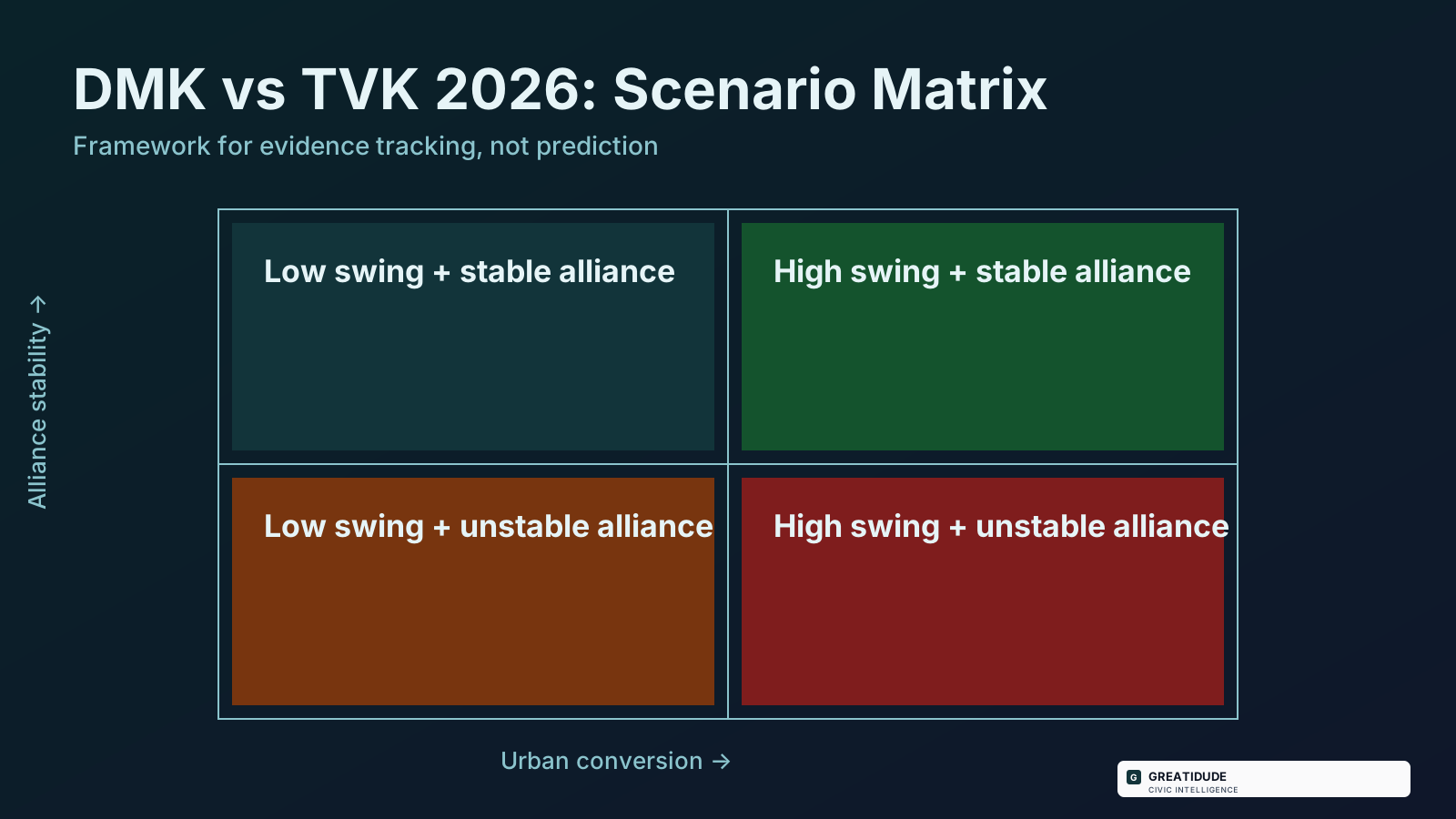
In 2021, DMK won 159 seats (including allies) and secured a 47.3% effective vote share across Tamil Nadu. The DMK's core strength is in urban constituencies, welfare scheme popularity, and inter-caste coalition management. In 2026, DMK is defending its incumbency and organizational reach.
TVK, launched in 2023 by former Bigil actor Vijay, represents an attempt to consolidate anti-DMK and anti-AIADMK voters without a traditional party structure. TVK's appeal is primarily among youth, non-traditional voters, and constituencies where DMK-allied candidates may be weak. TVK's real test is converting offline fan energy into booth-level organization.
2021 DMK baseline: 47.3% effective vote share, won 159 of 234 seats (68% conversion). DMK's coalition included the weak-performing Congress (9 seats on 3.9% vote share), DMK+allies were nearly 2:1 against AIADMK.
2016 (pre-2021): AIADMK won 134 seats (57% of house), DMK won only 89 seats despite 37.7% vote share. This shows how coalition strength and seat arrangement affect outcomes.
TVK 2026 baseline: TVK has no prior assembly election data. Its 2023 bye-election performance in Erode East (won with 39.8% vote share in a 3-way fight) is the only benchmark. Extrapolating from one bye-election to 234 statewide seats is risky.
North (Chennai, Kanchipuram, Chengalpattu): DMK holds strong in Chennai city and suburbs. This is TVK's strongest region due to urban concentration. In 2021, DMK won 18 of 25 seats in this region. Look for TVK gains here.
Central (Villupuram, Tirupati, Ranipet): Mixed region. DMK won 12 of 16 seats in 2021. AIADMK has traditional strength in rural areas. TVK is weakest here due to low urban density.
West (Salem, Erode, Coimbatore, Nilgiris): AIADMK and regional outfits are strong. DMK won 20 of 43 seats in 2021. TVK's Erode East bye-election win was in this region, so TVK has some traction here. But agricultural voters (crucial in this belt) traditionally lean AIADMK or Pattali Makkal Katchi (PMK).
South (Madurai, Tirunelveli, Kanyakumari): DMK-friendly region. DMK won 26 of 41 seats in 2021. Traditional stronghold due to Dravidian movement legacy and EV Ramasamy (Periyar) legacy in this region. TVK has minimal presence here.
TVK launch (2023): Vijay announced TVK in 2023, focusing on youth, anti-corruption, and Tamil pride messaging. The party has zero administrative experience but significant celebrity capital.
Erode East bye-election (2023): TVK won the bye-election with 39.8% vote share in a 3-way fight (AIADMK 26.3%, DMK 15.5%). This was celebrated as a breakthrough, but it was a bye-election (lower turnout, reduced voter base, single-seat contest).
2026 electoral cycle: As of early 2026, TVK is registered as a national party (not a regional party like DMK). This changes candidate nomination rules but does not guarantee voter resonance. DMK has spent 2021-2026 implementing welfare programs and managing incumbency.
DMK's coalition (2021 baseline): Backward castes (MBC, OBC), minorities (Christians, Muslims), Scheduled Castes, and urban educated segments. Vote share: 47.3%.
AIADMK's coalition: Forward castes, upper-OBC segments, traditional rural networks. Vote share (2021): 41.8%.
TVK's untested coalition: Youth (18-35), anti-corruption voters, Tamil nationalists, and constituencies where incumbents are weak. TVK has not contested a full-scale assembly election, so caste-wise breakdowns are speculative. Bijay-factor (actor celebrity) is strongest among middle-class urban voters and youth.
Seat conversion: DMK won 159 seats on 47.3% vote share (68% conversion). AIADMK won 66 seats on 41.8% vote share (28% conversion). This 40-point gap in seat conversion was due to coalition design: DMK's allies (Congress, CPI) fielded candidates in complementary constituencies, avoiding three-way splits in DMK strongholds.
Turnout pattern: Urban constituencies (Chennai, Coimbatore city) had 60-65% turnout. Rural constituencies (Nilgiris, Tirunelveli) had 68-72% turnout. Low turnout in cities benefits parties with high organizational density (DMK); high turnout in rural areas benefits parties with traditional networks (AIADMK, PMK).
Margin tightness: In 2021, ~40 constituencies had margins under 5,000 votes. These are the "swing seats" that determine election outcomes. In 2026, watch for TVK vs. DMK fights in urban swing seats and AIADMK vs. DMK fights in rural swing seats.
TVK's online dominance: TVK has strong social media presence, youth engagement, and viral moments. But Twitter/Instagram activity does not directly translate to polling booth presence. In 2021, similar online enthusiasm for NOTA (None of the Above) and anti-incumbency movements did not materially change election outcomes.
DMK's ground machine: DMK has 40+ years of organizational history, mandal-level committees, booth-level cadres, and welfare scheme networks. This translates to voter mobilization. TVK does not have equivalent infrastructure in most constituencies.
What actually matters: Candidate quality, local grievance redressal, caste mathematics, alliance strength, and voter turnout. Not social media sentiment.
Start from Party Performance for macro trend, then inspect Candidates for affidavit-backed integrity indicators, and finally review Constituencies to test seat-level variation. Use MyVote to find your local ward, councillor, and MLA to understand local representation context.
Start from all candidates, then open one profile to verify affidavit, vote share, and track record.
Open candidates → Read focused answerFind your constituency first, then move to winner and challenger profiles in one click.
Open constituencies → Read focused answerCompare party-level fielding and quality metrics, then drill into candidate-level evidence.
Compare parties → Read focused answerGo from politician profile to promise tracker and validate supporting evidence links.
Verify promises → Read focused answer